Insurance Claims Management Software for Public Adjusters Handling Property Damage Claims

How to Compare Insurance Claims Management Software for Property Claims
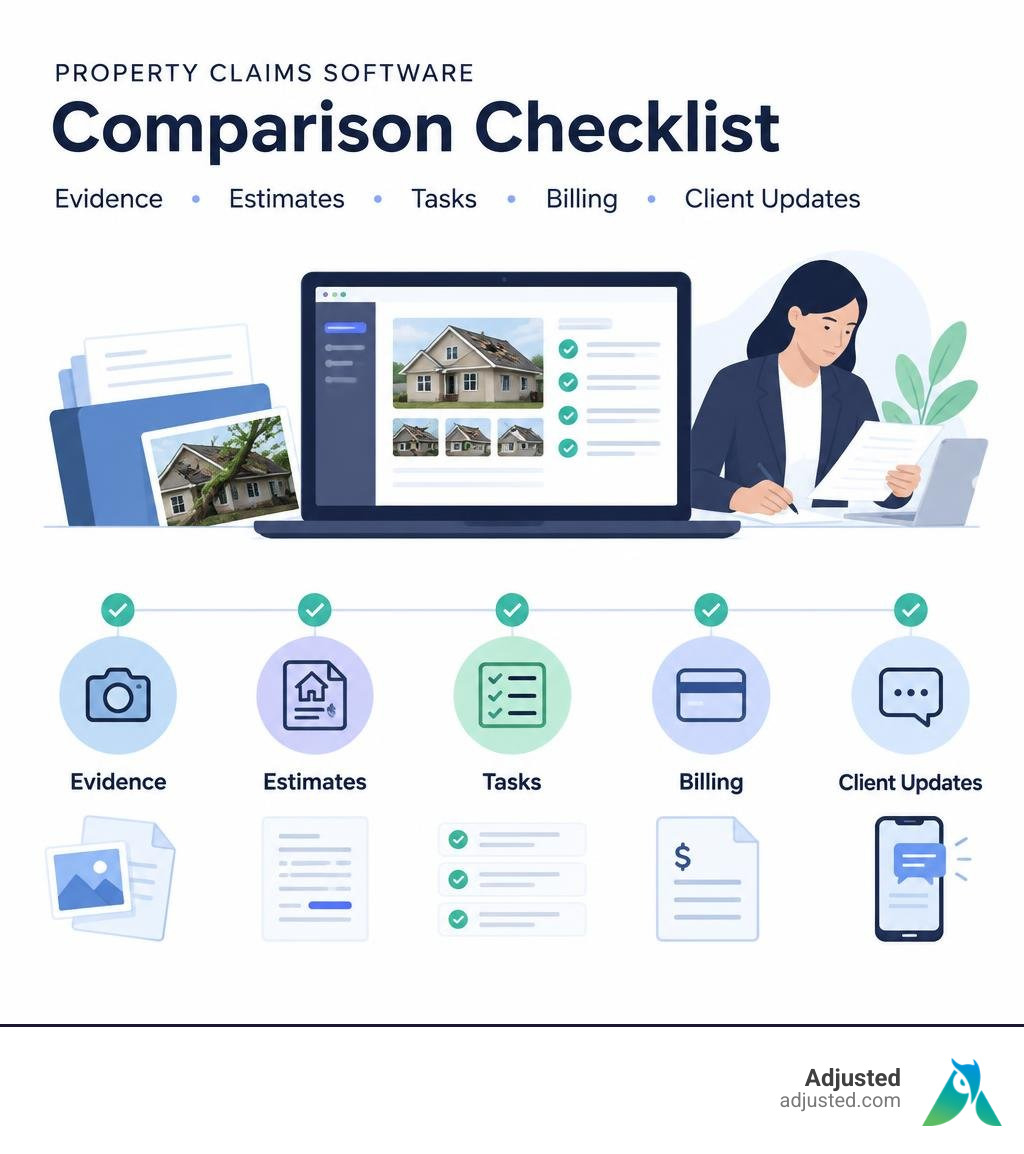
The best insurance claims management software for a public adjuster is the one that fits the work of a property claim. Compare how each system stores evidence, tracks tasks, reviews Xactimate estimates, manages billing, and keeps clients updated. In a demo, use one of your real claim scenarios. If your team still has to move files between tools or compare estimates by hand, the software may not solve your biggest problem.
I’m Nikolaos Stafford, Head of Sales & Marketing at Adjusted, with over a decade of experience across SaaS, AI, and insurance. I’ll use that experience to help you compare insurance claims management software by what it can do for your day-to-day work.
What Is Insurance Claims Management Software?
At its core, insurance claims management software is a centralized digital hub designed to manage, organize, and automate the entire lifecycle of an insurance claim. For property claims, this journey spans initial claim intake, document indexing, evidence tracking, scope review, negotiation, settlement, and fee collection.
Without dedicated technology, handling property damage claims often involves juggling spreadsheets, shared drives, email threads, and fragmented photo folders. Modern claims management software replaces this chaotic setup by organizing all records around the individual claim file. By standardizing everyday operations, teams can implement dependable insurance workflow automation that keeps files moving forward without manual handoffs.
How Claims Management Software Supports Public Adjusters
Public adjusters represent policyholders, meaning our daily priorities differ sharply from carrier adjusters. We need to prove the true scope of property damage, document every affected structure or item, identify overlooked policy provisions, and defend our estimates during tough carrier negotiations.
A platform tailored to public adjusters acts as an operational command center. It unifies high-resolution photo logs, matterport scans, engineering reports, weather data, and insurer communications. Using dedicated public adjuster software allows our teams to capture evidence in the field, run line-by-line estimate audits, and keep anxious policyholders updated with clear, automated notifications.
Core Features of Insurance Claims Management Software
When evaluating claims management platforms for property damage, ensure the system includes these foundational capabilities:
- Centralized Document & Media Storage: Secure, cloud-based storage that tags photos, videos, contracts, and carrier letters directly to the specific claim file.
- Task Tracking & Milestones: Automated reminders for statutory deadlines, proof-of-loss filings, carrier response windows, and inspection schedules.
- Fee Management & Invoicing: Tracking fee structures, contingency rates, expense logging, and client trust accounting in one place.
- Audit Trails & Activity Logs: A time-stamped record of every file upload, note, message, and status shift to protect against compliance disputes.
- Mobile Access: Seamless mobile capture so field adjusters can log notes, upload loss photos, and collect client signatures on site.
- Secure Unified Dashboard: A single view showing active claim stages, carrier bottlenecks, and settlement pipelines at a glance.
Having these insurance claims management software capabilities built into your daily operations eliminates administrative gridlock and lets adjusters focus on advocacy.
How to Compare Claims Software for Property Damage Claims
Finding the right platform means understanding how different claims tools are built. Most software solutions fall into four broad categories:
- Adjuster-Focused Platforms: Purpose-built for claim advocates. These tools emphasize scope capture, carrier communication tracking, estimate comparison, and client transparency.
- Carrier-Centric Enterprise Systems: Designed for large insurance carriers. These systems prioritize strict claims containment, policy administration, and reserves management rather than policyholder representation.
- Generic Configurable CRMs: Broad project management platforms customized with custom fields. While flexible, they lack native insurance features like Xactimate file parsing or claims-specific audit workflows.
- Point Solutions: Single-purpose tools designed solely for photo tagging, document signing, or field diagramming. While useful, they create data silos when used without a central platform.
| Solution Type | Workflow Fit for Public Adjusters | Estimate Handling | Integrations & APIs | Automation Depth | Total Cost & Setup |
|---|---|---|---|---|---|
| Adjuster-Focused Platform | High (native claims advocacy tools) | Native Xactimate & line-item analysis | Deep insurance API integrations | Automated intake, scoping, & task routing | Predictable SaaS pricing; fast rollout |
| Carrier-Centric System | Low (built for defense & reserves) | Carrier-side audit rules | Enterprise mainframe & legacy APIs | Strict rules-based workflow controls | High upfront cost; complex deployment |
| Generic Configurable CRM | Moderate (requires extensive customization) | Manual upload only (no parsing) | Standard webhooks & zapier connectors | Basic task reminders and status updates | Lower initial license; high setup costs |
| Point Solutions | Low (solves only one piece of the puzzle) | Isolated calculation or markup | Limited cross-platform sync | Minimal cross-file automation | Multiple subscriptions add up quickly |

Insurance Claims Management Software for Public Adjusters: Essential Criteria
Property claims live and die by the estimate. Therefore, the single most critical factor for public adjusters is how cleanly a platform reads and analyzes estimation data.
Look for tools featuring advanced claims estimate review software that natively digests Xactimate files. Instead of spending hours comparing printed carrier estimates against your own line by line with a highlighter, modern software highlights scope omissions, unit-price variances, and missing trade items automatically. Add strong collaboration tools, customizable reporting, and scalable multi-office permissions, and your practice gains a major competitive edge.
What to Evaluate in a Software Demonstration
Do not settle for a vendor’s canned presentation. To truly test a platform, bring a complex, messy property claim from your archives—complete with supplemental estimates, carrier denials, and extensive photo logs.
During the demonstration, evaluate:
- Usability: Can your team log notes, adjust loss reserves, and locate photos within two clicks?
- User Permissions: Can you easily restrict financial data from external contractors while granting full access to lead adjusters?
- Data Migration: What is the exact process for importing open claims and contact histories from your legacy system?
- Support & Training: Does the vendor provide dedicated onboarding and live customer support?
- Transparent Value: Review the vendor’s pricing structure to verify whether costs scale per user or per claim.
When you schedule a demo, test these exact scenarios live on screen to ensure the software holds up under real-world claims pressure.
How Software Improves Claims Speed, Costs, and Customer Experience
Managing property damage claims manually drains hours every week. Adopting specialized software delivers measurable operational improvements across every stage of the claims lifecycle:
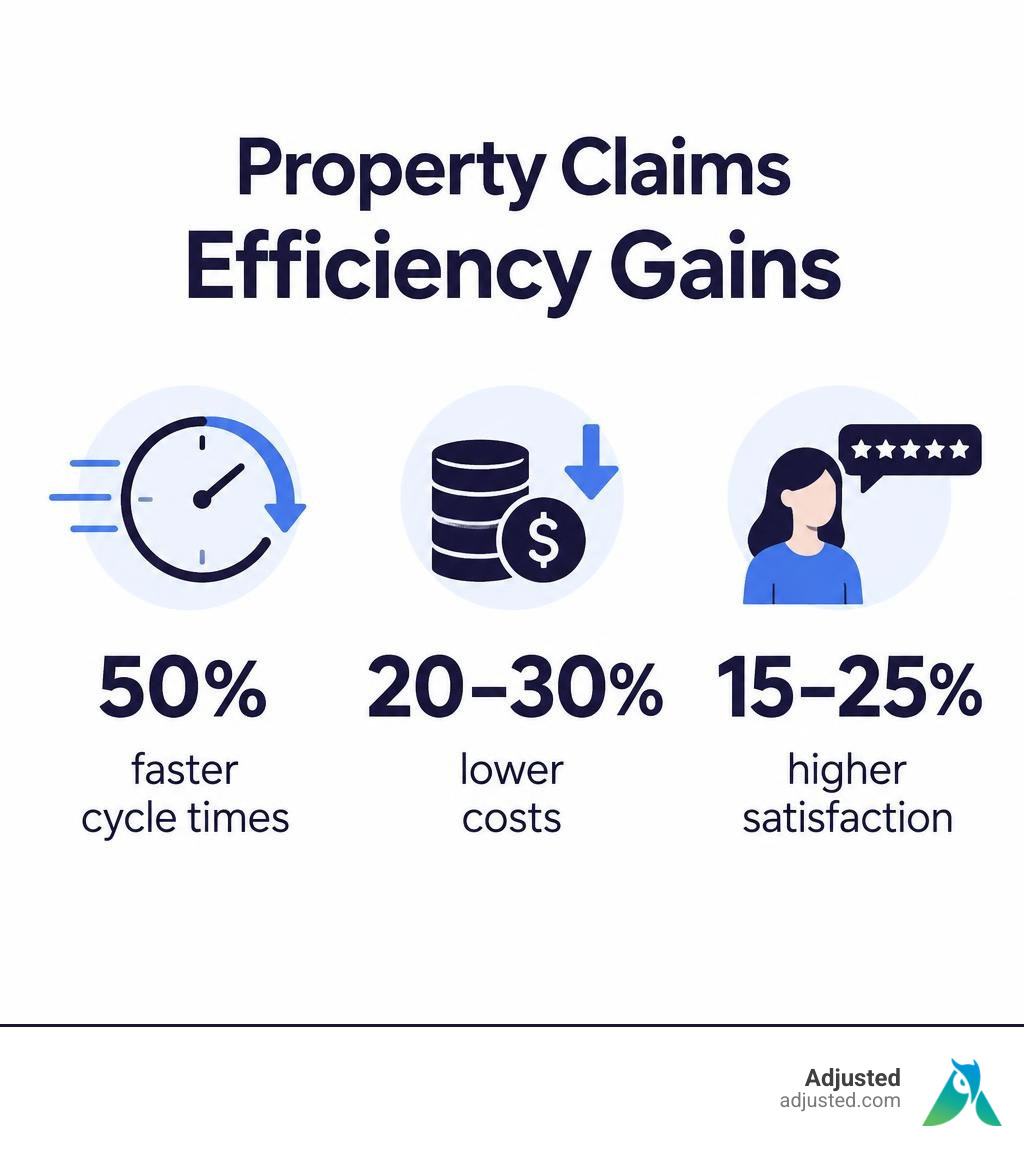
- 50% Faster Processing: Modern software can reduce claims processing time by up to 50%, shrinking cycle times from months to weeks.
- 20–30% Lower Claims Costs: Removing duplicate data entry, missed deadlines, and billing errors delivers an average 20–30% reduction in total claim-handling costs.
- 15–25% Higher Client Satisfaction: Automated updates, transparent client portals, and faster settlements improve client satisfaction scores by 15–25%.
When policyholders suffer severe property damage, clear communication is essential. Consumer resources like the NAIC Homeowners Insurance Guide consistently stress the importance of thorough documentation and responsive communication during property losses. Automated status updates keep policyholders informed, reducing inbound calls and building trust.
How Insurance Claims Management Software Uses AI and Automation
Artificial intelligence has transformed modern claims handling from static record-keeping into proactive, intelligent operations. Using AI insurance claims software, teams can automate repetitive administrative chores and focus on high-value negotiation.
Key automation capabilities include:
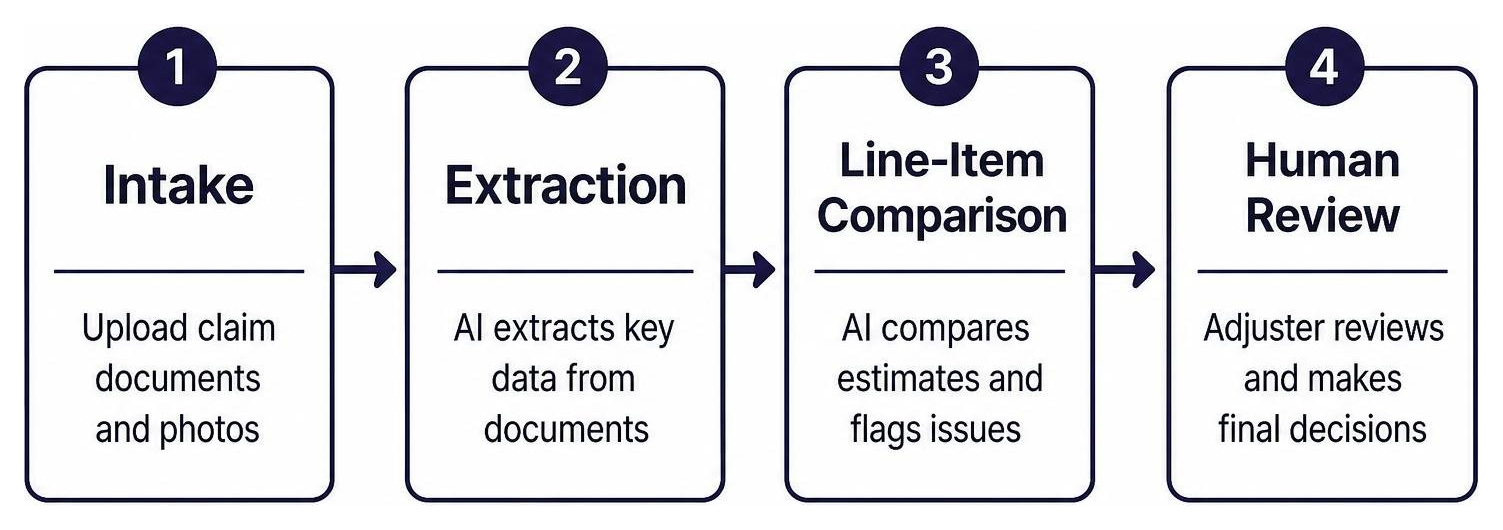
- Intelligent Document Extraction: Machine learning models instantly read complex documents—such as policy declarations, carrier denial letters, and engineering reports—pulling policy limits, deductibles, and endorsement codes without manual entry.
- Smart File Triage: Systems flag complex structural claims that require immediate field inspections while routing routine supplementary items to office staff.
- AI-Powered Estimate Comparison: Software compares your estimate against the carrier’s line items, automatically flagging omitted line items, code upgrades, depreciation errors, and lowball labor rates.
- Human-in-the-Loop Control: While automation handles the busywork, adjusters retain complete oversight, making it easy to stop drowning in paperwork with automated claims processing while preserving expert judgment.
Integrations, Fraud Detection, and Compliance
A modern claims platform does not live on an island. It connects smoothly with your broader business ecosystem via secure APIs, linking your accounting tools, specialized estimating software, and client CRM records.
At the same time, claims systems bolster risk management and compliance. By integrating automated identity verification, metadata inspection on loss photos (verifying timestamps and GPS coordinates), and anomaly detection, software helps catch fraudulent documents or duplicate submissions before they cause issues.
Maintaining complete, unalterable audit logs ensures your practice complies with state licensing standards, insurer communication rules, and frameworks such as the NIST AI Risk Management Framework for responsible, unbiased automated processing.
Implementation Risks and Best Practices
Transitioning to a modern claims platform is a strategic upgrade, but without a clear plan, implementation can run into common hurdles:
- Legacy Data Migration: Old files often contain messy naming schemes and duplicate records. Cleanse your active database before importing it.
- Cybersecurity & Data Privacy: Property claims contain sensitive client data, mortgage numbers, and financial records. Opt for secure cloud-based insurance software that offers robust encryption, role-based access, and automated backups.
- Staff Resistance: Adjusters comfortable with their personal spreadsheet systems may resist new platforms without proper change management and hands-on training.
Investing in these systems aligns with major market trends. Industry data shows that 70% of insurance organizations planned significant increases in claims automation investments heading into 2025 and 2026. Furthermore, the global claims management software market is projected to reach $15.2 billion by 2027, growing at an annual rate of 8.5%. Modernizing your tech stack ensures your team keeps pace.
How to Select and Roll Out a Claims Platform
To guarantee high adoption and a rapid return on investment, execute your software rollout in structured stages:
- Define Core Operational Requirements: List non-negotiable needs (e.g., native Xactimate parsing, client SMS portals, mobile photo tagging).
- Run a Controlled Pilot: Test the platform with a small, tech-savvy group of adjusters on live claims to iron out workflow kinks.
- Verify System Integrations: Connect and test data flows across your email systems, accounting platforms, and external storage tools.
- Deploy Scaled Training: Conduct practical, role-specific training sessions using actual claim files rather than abstract manuals.
- Monitor Adoption Metrics: Track key performance indicators—such as file completion speed, estimate review turnaround, and team login frequency—to measure success.
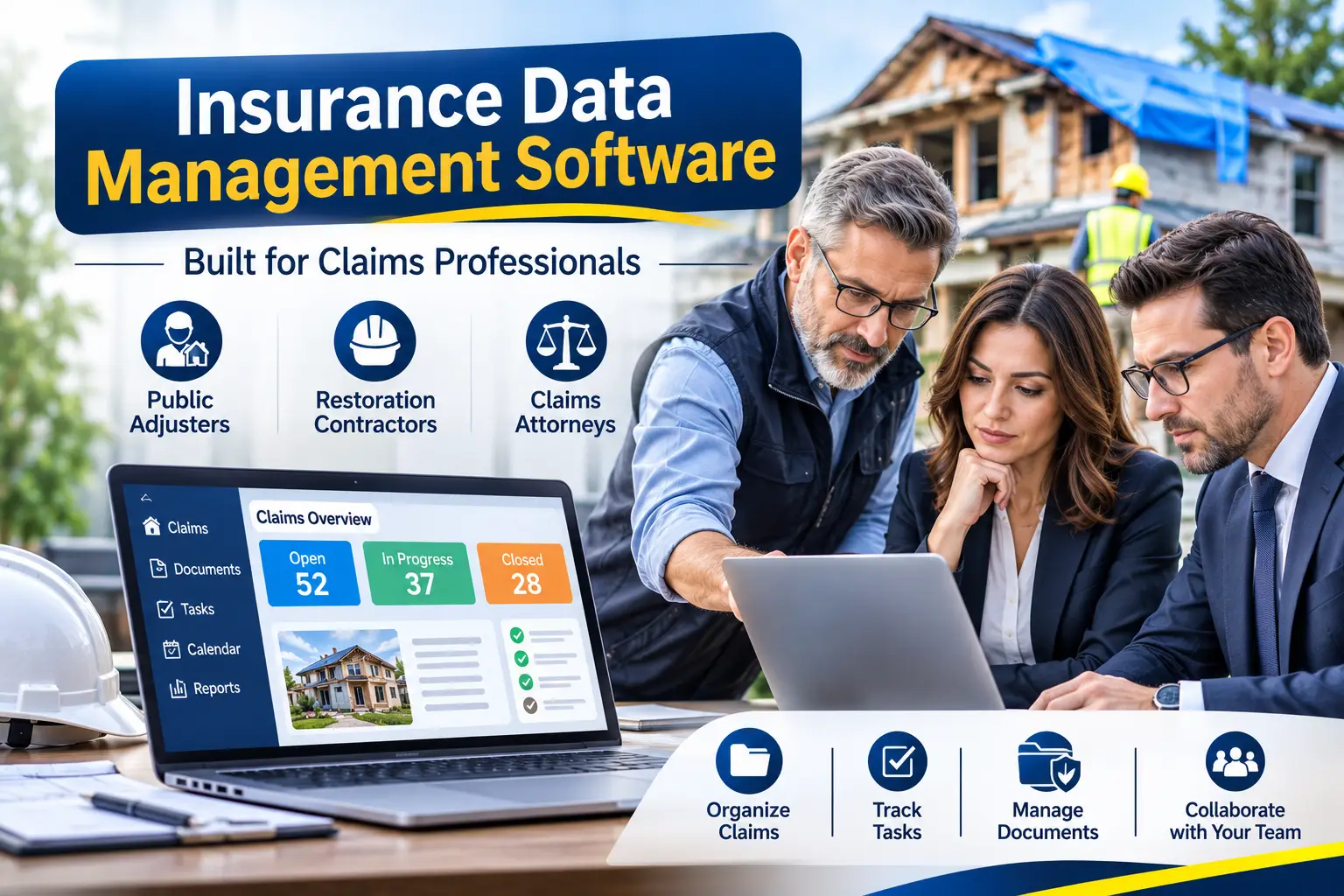
These structured deployment principles apply across property claims disciplines, whether supporting claims management software for attorneys managing bad-faith property litigation or restoration claims management software tracking complex mitigation scopes. Setting clear benchmarks ensures every team member benefits from your upgraded insurance claims workflow automation.
Frequently Asked Questions About Insurance Claims Management Software
How does claims software help public adjusters handle property damage claims?
Claims software centralizes all loss documentation, photos, policy forms, and adjuster notes into a single secure file. It automates repetitive administrative follow-ups and helps adjusters quickly analyze estimates, compare line items, and spot omitted damage scopes.
Can claims management software work with existing policy, billing, and CRM systems?
Yes. Modern claims platforms use open APIs and secure webhooks to exchange real-time data with external billing software, client management tools, and document storage repositories, preventing duplicate data entry across platforms.
How should an adjuster evaluate AI features and data security?
Look for systems that use artificial intelligence as an assistant rather than a black-box decision maker. The software should clearly show where extracted data originated, let adjusters confirm automated suggestions, and protect your files with enterprise-grade encryption, SOC 2 compliance, and granular user permissions.
Conclusion
Choosing the right insurance claims platform comes down to workflow fit. A system that looks impressive in a slide deck but cannot read an estimation file, organize field photos, or surface carrier omissions will only slow your team down.
When you evaluate claims technology, focus on tools that solve the specific challenges of property claims: native estimate parsing, automated file tracking, secure document organization, and clear client communication.
At Adjusted, we built our AI-powered claims management software specifically for property insurance professionals. Our platform natively parses Xactimate estimates, compares them line by line with AI to uncover missed items, and unifies all your files, tasks, and billing into one intuitive dashboard.
Ready to eliminate administrative bottlenecks and accelerate your property claim resolutions? Explore Adjusted’s claims management solutions today.