
Insurance Data Management Software for Claims Professionals


What Insurance Data Management Really Means
TLDR; Public adjusters share estimating tools with carriers, but daily claim work usually runs on generic CRMs and spreadsheets. This post covers what a tool built for that work needs.
Try the search yourself. Most of what loads is aimed at insurance carriers, enterprise data warehouses, compliance dashboards, tools built for underwriting teams at big companies. The people who actually open a claim file every day rarely show up in the results at all.
Makes sense when you think about where the ad budgets come from. Carriers pay for enterprise software, so that’s who the content talks to. But public adjusters, restoration contractors, and the attorneys running these cases day in and day out are solving a totally different problem, and we ran into this same gap writing our guide to cloud based insurance software.
Why Most Results Miss the Point
Carrier platforms are optimized for governance and risk reporting, which is fair, that’s their job. But it does nothing for someone bouncing between five tabs trying to keep one claim file together before a deadline hits.
Who This Software Should Actually Serve
Cut through the vendor talk and it’s not complicated. A document, a photo, an estimate, a message, if it’s tied to a claim, it lives with that claim. State regulators, loosely tied together through the NAIC, want claims handled on time. Messy files are usually why one doesn’t.
The Hidden Cost of Poor Data Management in Claims Work
Nobody plans for scattered data. It just happens. An email here, a shared drive there, a sticky note nobody remembers writing. Then the claim’s taking longer than it should and nobody can say exactly why.
Ask a public adjuster about this and they won’t need an audit to bring up an example.
Where Claims Data Usually Goes Missing
- Inspection photos sitting on someone’s phone, never uploaded to the file
- Supplement estimates going back and forth by email, with nobody sure which version is current
- Billing kept in a separate tool from the claim
- Client messages spread across texts, calls, and more than one inbox
Why This Slows Down Every Single Claim
The cost shows up quietly. A photo that never got uploaded turns into a phone call nobody wanted to make. Keep billing in its own corner and someone’s stuck reconciling numbers by hand right before an invoice goes out, every time.
None of that gets a claim closed faster. It definitely doesn’t get anyone paid faster either. Fix it, and most firms notice within a month.
What Good Claims Data Management Looks Like

One claim record. Photos, estimates, notes, all of it, in one spot. Pull up what you need in seconds instead of hunting for twenty minutes. That’s really the whole idea, not another app to babysit every morning.
Centralizing Every Document in One Place
Photos, estimates, invoices, policy documents. All of it belongs inside the claim record, not scattered somewhere else. Good document management just makes that the default. Proving something to a carrier becomes one click instead of a dig through old email threads.
Structuring Unstructured Data
A photo can’t search itself. Neither can a scanned PDF, or a note somebody typed up after a call. Decent systems pull the useful stuff out automatically. Finding something later shouldn’t mean flipping through hundreds of files by hand.
Keeping a Clear Audit Trail
Every edit, every note, every message, it should all log itself in the background. No checklist, nobody has to remember. That record matters the second a claim gets challenged, and clients notice it too, they want a straight answer about what happened and when.
Insurance Data Management vs Claims Management vs Policy Administration
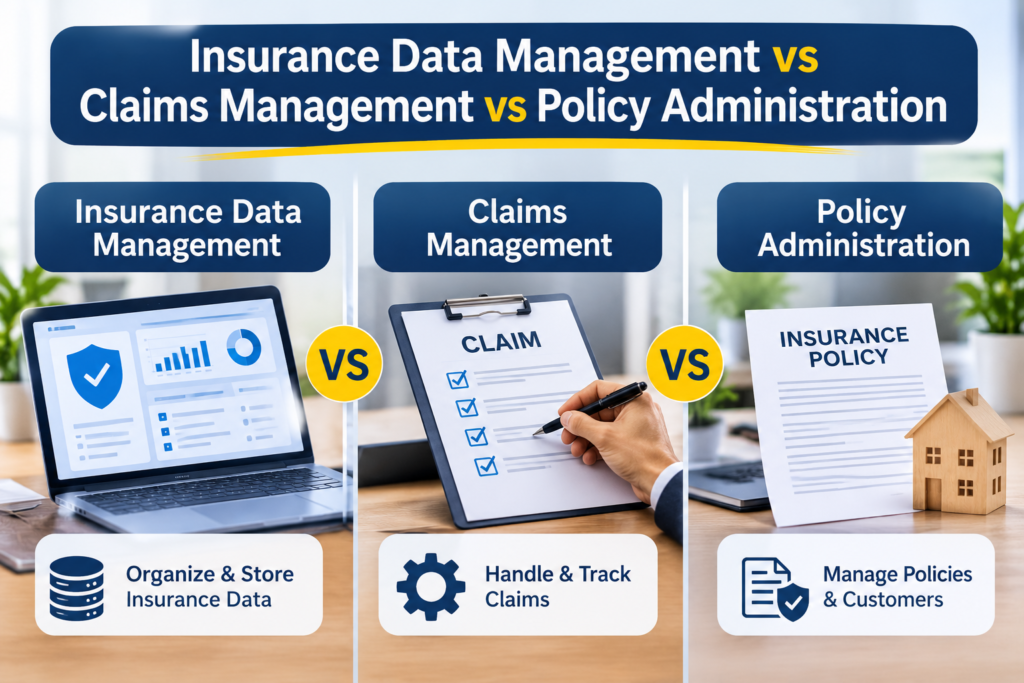
People confuse these three constantly, worth untangling before any money changes hands. Each one covers a different stretch of the insurance process, and each gets regulated a little differently depending on the state.
| Term | What It Actually Covers | Who It Is Built For |
| Policy Administration Software | Issuing, renewing, and tracking policies | Carriers and underwriters |
| Insurance Data Management Software | Capturing and securing claim related data | Claims teams, separately from carrier data departments |
| Claims Management Software | Running the full claim workflow, intake to settlement | Public adjusters, contractors, and attorneys |
The third row is where claims professionals belong, full stop. A generic CRM wasn’t built to follow a claim from intake to settlement, and tools built for carriers weren’t designed around how an adjuster’s firm runs day to day.
Must Have Features in Claims Focused Data Management Software
Not all software in this category is built the same. A few features separate the real thing from a spreadsheet wearing a nicer interface.
What to Actually Look For
- Native Xactimate support, so nobody’s retyping numbers by hand
- AI that checks an initial estimate against a supplement and flags what changed
- Security independently verified through something like SOC 2 Type II, not just a vendor’s word for it
- Billing and time tracking tied directly to the claim, not off in a separate system
Why Each of These Actually Matters
Reading estimates natively saves hours that would otherwise go into manual entry and line by line double checking. Many public adjusters, represented nationally through NAPIA, depend on that kind of accuracy with every client they take on.
Client data that’s genuinely sensitive deserves real, verified protection, not a vendor’s assurance. And billing that’s tied to the claim means invoices go out right the first time, no scramble at month end.
How Adjusted Brings This Together
We built Adjusted around this problem from day one. We didn’t tack it on later because customers complained. Every claim file pulls documents, photos, estimates, and billing into one spot. The platform holds SOC 2 Type II certification too, so clients don’t just have to take our word on security.
The Estimate Analyzer reads Xactimate files natively. It catches the line item discrepancies a tired set of eyes misses on a Friday afternoon. Running a claim shouldn’t mean five tabs open at once. And the team isn’t starting over from scratch, the layout just tracks how claims already move through the office.
Frequently Asked Questions
What is insurance data management software?
It’s software that captures and protects everything tied to a claim or policy. Documents, photos, estimates, client messages, all kept in one place instead of scattered everywhere.
How is claims data management different from policy administration software?
Policy administration handles the policy itself, quote through renewal. Claims data management picks up once a loss gets reported. That’s when the real work starts.
What should public adjusters look for in a data tool?
Native Xactimate support, independently verified security, and billing tied directly to each claim rather than living somewhere else entirely.
Is claims data in these platforms actually secure?
SOC 2 Type II certification means the platform has already been through an independent audit, security, availability, confidentiality, all of it. At this point, that’s close to table stakes for clients.
Can software read and compare Xactimate estimates automatically?
Yes. Adjusted, for instance, reads Xactimate files natively. It compares an initial estimate against a supplement line by line and flags differences as they come up.
Do restoration contractors need different features than public adjusters?
Mostly the same features work for both. Contractors just lean harder on photo documentation and job costing for individual claims.
How long does it take to switch from spreadsheets to real claims software?
A few weeks, usually. Existing claims and contacts can be imported instead of typed in one at a time.
Bottom Line
There’s enough to deal with in claims work without the software fighting back too. Scattered data across apps, emails, and spreadsheets eats hours every week. Nobody gets those hours back. And clients feel that drag, even when they don’t say it out loud.
Adjusted pulls every claim file into one organized record. It’s built for the people running the claim, not the carriers they’re negotiating with. Schedule a demo. See what one week without the usual chaos actually feels like.
