
SaaS for Insurance Companies Explained for Real Claims Teams


What Is SaaS for Insurance Companies
SaaS is cloud insurance software, and claims teams need their own version of it. Quick definition first. SaaS, short for software as a service, basically just means you pull it up in a browser instead of installing anything. No server in a closet. No IT guy babysitting updates at 11pm on a Tuesday. You just log in, same as checking email.
Insurance companies have leaned into this hard. Policy tools, billing, claims handling, a lot of it now runs in the cloud under one subscription. The numbers back it up too. One market report put the global insurance software market past 10 billion dollars, with SaaS now pulling ahead of older on premise setups by a wide margin (Business Research Insights). That’s not a small shift.
How the SaaS Model Actually Works
Nothing to install, nothing sitting on a hard drive in your office. You pay a subscription, log in from your laptop or your phone, and the vendor handles everything on the backend. Patches, uptime, security, all of it.
That matters a lot in insurance specifically, since this is an industry built on sensitive data about real people’s homes, cars, and finances. Deloitte’s research on insurance technology trends makes the same point, noting that carriers and claims organizations keep shifting bigger chunks of budget toward cloud and AI tools just to keep pace (Deloitte). Makes sense. Falling behind here isn’t cheap.
Core Applications of Insurance SaaS
Here’s the thing people miss. Insurance SaaS isn’t one product. It’s a bundle of tools that used to come from five different vendors who never bothered talking to each other, and stitching those systems together used to be half the job.
Policy Administration
Issuing policies, handling renewals, tracking changes, all from one dashboard. No more hunting through a filing cabinet for last year’s paperwork.
Underwriting and Risk Tools
Underwriters use these to size up risk and set premiums without waiting on another department to send over a spreadsheet.
Claims Management
This is the one claims folks actually live in. Intake, documentation, back and forth with everyone involved, settlement, it’s all here, and honestly it touches almost everything you do all day.
Billing and Invoicing
A decent platform ties every payment back to the claim it belongs to automatically. Nobody wants to update a billing spreadsheet by hand on a Friday at 5pm.
Why So Many Insurers Are Switching
Old legacy systems are expensive and clunky to maintain. SaaS takes that weight off, which is why even smaller firms, the ones that used to assume cloud tools were only for giant carriers, are jumping in now too.
Lower Costs, Less IT Headache
No server to buy. No late night patch job. You pay monthly or yearly and that’s basically it.
Add it up over a few years and the savings are real. Money that used to go toward hardware contracts can go toward actually growing the business.
Real Security, Not Just a Sales Pitch
Good SaaS vendors take security seriously because their whole business depends on it. Plenty carry independent audits like SOC 2, meaning an outside firm actually checked their security practices instead of just trusting the vendor’s word for it (AICPA).
That’s not just a checkbox either. One bad breach involving claimant data can follow a firm around for years.
Room to Grow Without Starting Over
A two person adjusting shop and a fifty person firm can run on the exact same platform. You add seats as you grow instead of ripping everything out later and starting over.
SaaS vs On Premise Software
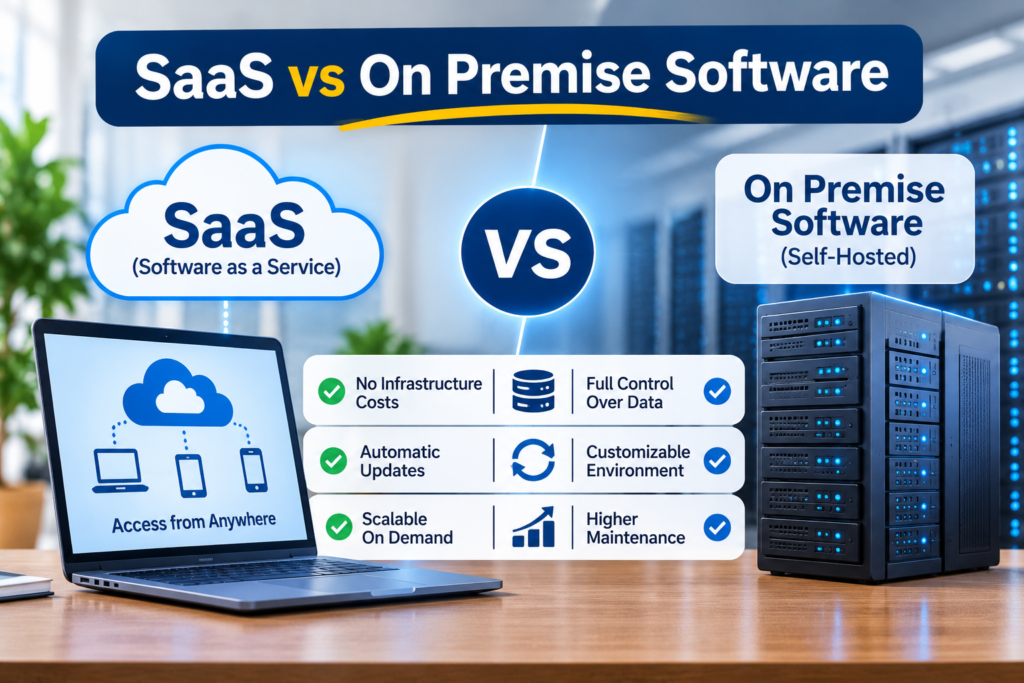
Quick side by side, since people always ask which one actually wins once you factor in day to day reality, not just the sales pitch.
| Factor | SaaS | On Premise |
| Setup cost | Low, subscription based | High, paid upfront |
| Maintenance | Vendor handles it | Falls on your IT team |
| Updates | Automatic | You schedule them |
| Access | Any device, anywhere | Usually on site only |
| Scalability | Add users easily | Often needs new hardware |
Why Claims Teams Need Something Different
Most of what’s sold as insurance SaaS was built for carriers, underwriters, and policy admin staff. If you work every day, that software usually falls short, no matter how smooth the sales demo looked.
Public adjusters, restoration contractors, and P and C attorneys aren’t pushing policies around all day. They’re buried in individual claim files, estimates, and deadlines, and a generic platform just wasn’t built with that in mind.
Public Adjusters
Ever juggled a dozen open claims at once? Photos, estimates, notes, every email thread, it all needs a home, and that home shouldn’t be split across your inbox and three different shared folders.
Put it all in one claim record and pulling up a file takes two minutes instead of a lost afternoon.
Restoration Contractors
Contractors need billing tied straight to the job and the claim, so invoices and time entries hold up if a dispute drags on six months later.
Without that link, good luck proving what work happened and when.
P and C Attorneys
Attorneys handling claim disputes need a record that actually holds up in a dispute. Every email, document, and estimate revision needs a timestamp and a clear trail.
Software built for this keeps that trail intact on its own, instead of hoping someone remembered to save an attachment back in March.
What Claims Specific SaaS Should Actually Do
If claims work is your day job, a generic CRM usually creates more problems than it solves. Adjusted’s claims management tools were built around this exact gap, so here’s what actually matters when you’re comparing options.
Native Xactimate Integration
Honestly, if someone on your team is still retyping Xactimate numbers into another system by hand, that’s half a day of the week gone for nothing. Adjusted’s own estimate analyzer reads initial and supplement estimates directly and runs them through AI line by line, so a missed discrepancy gets caught before the check goes out, not after.
Billing Tied to the Claim
This one’s simple, and it’s exactly where a lot of firms get burned later. An invoice or a logged hour that isn’t tied to a specific claim is basically unprovable six months down the road. Good billing tools link that automatically, so cash flow stops being a mystery.
Security You Can Actually Verify
Claims data is sensitive, full stop. The real difference between a vendor that talks about security and one that actually has it usually comes down to outside audits. Bodies like the NAIC set the regulatory backdrop insurers and claims pros operate under in the first place, which is exactly why certified, audited platforms carry real weight.
How to Actually Choose the Right Platform
Forget the feature list for a second. Start with whatever actually annoys you on a daily basis, then go find software that fixes that one thing. When you get a demo, bring a real, messy claim file instead of letting the vendor run their polished script, and just watch how it handles data that refuses to cooperate.
There’s a real difference between a platform built from scratch for claims work and a sales CRM that slapped a few insurance terms on top afterward. Adjusted’s solutions page is a fair place to see that difference side by side. And before you sign anything, check it supports your file types, ask how long onboarding actually takes, and call a couple of references close to your own size. If a vendor dodges any of that, take the hint.
FAQs
Is SaaS actually safe for sensitive claims data? Mostly, yeah, assuming the vendor carries independent audits like SOC 2 and keeps access genuinely locked down. A cloud setup often ends up safer than a server quietly sitting in someone’s back office closet.
Do public adjusters really need different software than carriers use? They do. Carrier tools revolve around policies and underwriting, full stop. Adjusters are living inside individual claim files, documents, and billing tied to one case at a time, which is a completely different job.
How does SaaS pricing stack up against on premise software? Pretty differently. SaaS is a predictable fee, monthly or yearly. On premise means a big check upfront, then IT costs that never really go away.
Can insurance SaaS integrate with tools like Xactimate? It should, if it’s any good. A real claims focused platform reads Xactimate estimates on its own instead of making someone enter the same numbers into two different systems.
How long does switching from on premise to SaaS take? A few weeks, usually, for the core claim data. Longer if there’s a mountain of historical records to migrate, though most vendors will assign someone to help you through onboarding anyway.
Will my team actually adopt new software, or will it just collect dust? Depends entirely on fit. Software built around a generic sales process gets ignored fast. Software built around how claims work already happens tends to stick around instead.
Bottom Line
Here’s the blunt version. Generic insurance SaaS wasn’t built with your actual claim work in mind, and that gap is quietly costing you hours, and dollars, every single week. If you’d rather run everything from one platform built specifically for public adjusters, restoration contractors, and P and C attorneys, go ahead and schedule a demo with Adjusted and see the difference for yourself.
